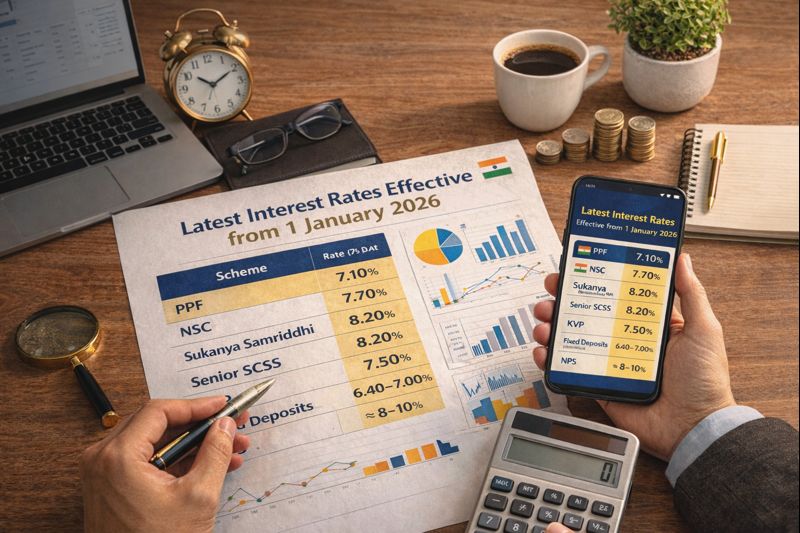
As of January 1, 2026, the Government of India has retained the interest rates on most popular small savings and post office schemes for the quarter January–March 2026 without changes from the previous quarter. This provides stability and predictability in returns for savers and long-term investors.
Below is a comprehensive list of current interest rates for key financial instruments and savings schemes in India:
1. Small Savings & Post Office Schemes (Jan-Mar 2026)
Post Office Small Savings Schemes
These are government-backed instruments that provide safe, fixed returns and, in many cases, tax benefits:
| Scheme | Interest Rate (%) p.a. | Notes |
|---|---|---|
| Public Provident Fund (PPF) | 7.10% | Compound annually; tax-free interest & maturity |
| National Savings Certificate (NSC) | 7.70% | 5-year lock-in; interest taxable but qualifies for Section 80C |
| Sukanya Samriddhi Yojana (SSY / SSA) | 8.20% | High rate; tax benefit under Section 80C; interest tax-free |
| Senior Citizen Savings Scheme (SCSS) | 8.20% | Quarterly payout; designed for senior citizens |
| Kisan Vikas Patra (KVP) | 7.50% | Investment doubles around ~115 months |
| Post Office Savings Account | 4.00% | Liquid savings, low return |
| 1-Year Time Deposit | 6.90% | Fixed term deposit at post office |
| 2-Year Time Deposit | 7.00% | Fixed term |
| 3-Year Time Deposit | 7.10% | Fixed term |
| 5-Year Time Deposit | 7.50% | Long-term fixed deposit |
| 5-Year Recurring Deposit | 6.70% | Recurring monthly deposit |
| Monthly Income Scheme (MIS) | 7.40% | Monthly payout |
| Note: These rates were not changed for January–March 2026 quarter by the Finance Ministry, continuing from the October-December 2025 rates. |
2. Public Provident Fund (PPF) – Detailed View
- Interest Rate: 7.10% p.a. (as per the widened notification continuing into Jan-Mar 2026)
- Compounding: Annually
- Lock-in: 15 years (extendable in 5-year blocks)
- Tax Treatment:
- Contributions eligible for deduction under Section 80C
- Interest and maturity value are fully tax-free
PPF remains one of the most popular long-term, risk-free savings instruments in India.
3. Sukanya Samriddhi Yojana (SSY)
- Interest Rate: 8.20% p.a. for Jan-Mar 2026 quarter
- Who it is for: Savings scheme for a girl child (Beti Bachao, Beti Padhao initiative)
- Minimum investment: ₹250 per year
- Maximum: ₹1.5 lakh per year (80C benefit)
- Tax Treatment: Interest and maturity amount are tax-free
SSY currently offers one of the highest risk-free government savings returns in India, making it a top choice for long-term child education/marriage savings.
4. National Savings Certificate (NSC)
- Interest Rate: 7.70% p.a.
- Maturity: 5 years
- Tax Benefits: Investment qualifies under Section 80C
- Interest: Compound annually but payable at maturity (taxable)
NSC is a popular choice for safe savings with decent interest and tax deduction under 80C.
5. Senior Citizen Savings Scheme (SCSS)
- Interest Rate: 8.20% p.a., one of the highest among government small savings schemes.
- Who it is for: Individuals above 60 years
- Payout: Quarterly
- Tax Benefit: Investment qualifies for deduction under Section 80C (subject to overall limit)
SCSS provides attractive regular income for senior citizens.
6. Post Office & Government Time Deposits
These deposits (1-year, 2-year, 3-year, 5-year) are similar to bank FDs but guaranteed by the government:
- 1-Year TD: 6.90%
- 2-Year TD: 7.00%
- 3-Year TD: 7.10%
- 5-Year TD: 7.50%
- 5-Year RD: 6.70%
- MIS (Monthly Income Scheme): 7.40%
- Savings Deposit Account: 4.00%
These offer decent fixed returns and can be used for laddering investment strategies.
7. Bank Fixed Deposits (FDs)
Unlike government small savings schemes, bank FD interest rates vary by bank and tenure and are not directly notified by the government.
Recent trends as of late December 2025 show that major banks like SBI and HDFC Bank have cut interest rates on several tenures of Fixed Deposits.
For example:
- SBI reduced FD rates on certain mid-term tenures (2–3 years) by a few basis points (e.g., from ~6.45% to ~6.40%).
- HDFC Bank also revised rates for some tenures.
These rates change frequently based on the RBI monetary stance, repo rates and competition among banks.
📌 Key point for FDs:
• General customers’ FD rates have softened slightly in late 2025.
• Senior citizens typically get ~0.50% higher than general FD rates.
• Bank FDs are taxable (TDS applies if interest > ₹50,000 in a year for individuals).
Always check specific bank FD rates before investing, as these vary widely by bank, tenure, and deposit amount.
8. National Pension System (NPS)
NPS interest or returns are market-linked, unlike fixed government schemes, because NPS invests contributions into the market equity, corporate bonds and government securities based on the investor’s choice of asset allocation.
- Expected returns: Historically around 8–10% (varies every year based on market performance)
- Tax Benefit: Contributions up to ₹1.5 lakh under Section 80C and an additional ₹50,000 under Section 80CCD(1B)
Since NPS returns are not fixed, always consider past performance and risk tolerance before investing.
Summary Table — Interest Rates (As of 1st January 2026)
| Scheme | Interest Rate (% p.a.) | Tax/Key Feature |
|---|---|---|
| PPF | 7.10% | Tax-free interest & maturity |
| NSC | 7.70% | Tax benefit under 80C |
| SSY (Sukanya) | 8.20% | Highest in small savings, tax-free |
| SCSS (Senior Citizens) | 8.20% | Quarterly payout |
| KVP | 7.50% | Long lock-in |
| Post Office TD (5 yr) | 7.50% | Government guaranteed |
| MIS | 7.40% | Monthly payout |
| Savings Deposit | 4.00% | Liquidity |
| Bank FDs | Varies (~6.40–7.00%) | Subject to bank policy |
| NPS | Market-linked (~8–10%) | Equity and bonds |
Visit www.cagurujiclasses.com for practical courses