Union Budget 2026
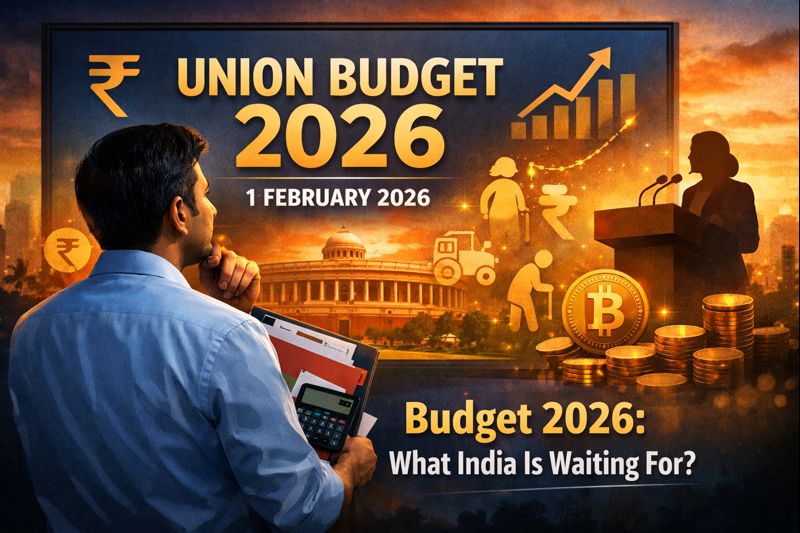
The Union Budget 2026 of India is scheduled to be presented on 1st February 2026 (Sunday) by the Finance Minister. The decision to present the budget on a Sunday had previously sparked debate, but it is now confirmed, and all preparations are under way for this significant economic event.
This budget comes at a crucial juncture: the new Income-tax Act, 2025 has been brought in with the aim of simplifying language and compliance, but it did not introduce major substantive changes in tax policy. Most substantive tax and regulatory reforms are now expected to be announced or clarified in Budget 2026 itself.
I. Macroeconomic Context & Budget Outlook
India’s economy has shown resilience, with stable growth trends, controlling inflation, and a focus on infrastructure and long-term growth enablers. The Budget 2026 is expected to address both short-term fiscal pressures and long-term structural reforms, balancing growth with fiscal discipline.
The government is likely to maintain its focus on capital expenditure, social welfare, technology adoption, and regulatory clarity across sectors like agriculture, health, women empowerment, start-ups, and new economy areas such as digital assets.
II. Expectations from Budget 2026
1. Taxation — Major Anticipated Changes
- Income Tax Rates & Structure: While major reductions in tax rates are not widely expected, there could be adjustments in tax slabs and thresholds to enhance disposable income and consumption demand.
- Capital Gains Tax: Current provisions for capital gains are being reviewed. There are expectations of rationalisation to align with investment sentiment and boost market participation.
- TDS Rationalisation: Proposals include simplification of TDS (Tax Deducted at Source) provisions to reduce compliance burden for businesses and taxpayers.
- ESOPs & Foreign Tax Credit: Clarifications or relief on ESOP taxation for global employees and effective Foreign Tax Credit claims could be part of Budget measures.
2. Sectoral & Social Focus
- Women’s Empowerment: Budget 2026 is widely expected to announce initiatives focused on women’s financial inclusion, employment, skill development, and safety nets.
- Agriculture & Rural Economy: Enhanced credit support, modernisation schemes, and income support mechanisms for farmers are likely to be announced.
- Senior Citizens: Possible expansion or continuation of concessions or welfare measures for senior citizens in terms of health and tax benefits.
III. Virtual Digital Assets (Cryptocurrencies) — Key Developments
1. New Regulatory Tracking & KYC Norms
Over the first weeks of January 2026, India’s Financial Intelligence Unit (FIU) has introduced stringent anti-money-laundering (AML) and Know-Your-Customer (KYC) regulations for cryptocurrency exchanges and Virtual Digital Asset (VDA) service providers. These new requirements aim to enhance transparency and traceability in crypto transactions by establishing strong identity authentication and user information recording standards. Key aspects include:
- Live Selfie Verification: Users must provide a live selfie where liveness detection software checks eye blinks, head movements, etc., to ensure a real person is present and reduce the risk of deepfake or static photo misuse.
- Geo-Location and Tracking: Exchanges must capture precise geographic data (latitude/longitude), date, time, and IP address when users onboard and conduct transactions to increase traceability and help law enforcement track suspicious activity.
- Enhanced KYC Documentation: In addition to PAN, users must provide secondary identification (such as passport, Aadhaar, or voter ID) and complete OTP verification for email and mobile numbers.
- Bank Account Verification: A “penny-drop” test (nominal transaction) confirms the bank account’s authenticity and ownership.
- Regular KYC Updates: High-risk category users must refresh their KYC details more frequently, while standard users must update annually.
- Transactions Monitoring & Reporting: Crypto service providers must monitor transactions and generate reports when suspicious activity is detected, such as possible links to crime or financing of terrorism.
These measures signify tightening of regulatory oversight to prevent money laundering, terrorism financing, fraud, and misuse of anonymous or decentralised financial flows. The government is aligning crypto sector compliance with broader financial regulatory standards to boost investor protection and systemic integrity.
At the same time, income tax authorities have highlighted the challenges in tracking decentralised crypto transactions and ensuring tax compliance, given anonymous wallets and cross-border exchanges.
2. Taxation on Crypto
Under the current tax regime:
- 30% flat tax applies on gains from sale or transfer of virtual digital assets without allowance for offsetting losses against gains.
- 1% TDS is levied on crypto transaction flows, which industry players argue creates a liquidity and capital blockage for active traders and can push investments to offshore platforms.
Crypto stakeholders now expect Budget 2026 could consider:
- Reduction in TDS rates (industry proposes 0.01%) to improve market efficiency and keep trading activity on Indian platforms.
- Permission for netting losses against gains to rationalise tax treatment and align it with traditional financial assets, making long-term investing more attractive.
- Broad discussions on whether taxation rules could be more flexibly aligned with income tax slab treatment or differentiated based on holding period.
These expectations reflect a push from the crypto industry for tax relief and rationalisation, without compromising compliance and reporting. There is also discussion that a stronger regulatory structure may involve delineation of a designated regulator for crypto — proposals have been discussed around SEBI handling exchange regulation and RBI monitoring cross-border flows — but formal announcements are dependent on Budget and post-Budget policy clarifications.
IV. Indirect Tax and Regulatory Landscape
GST and Customs Duty
- Calls for uniform GST rates and faster refund mechanisms are likely to be part of industry representations.
- Customs duty structures on import of capital goods and technology products are anticipated to be rationalised to support manufacturing and exports.
Regulatory Integration
- Discussions are ongoing to formalise a single regulatory framework for crypto and VDAs, narrowing the gap between multiple regulators’ involvement and ensuring clearer compliance channels.
V. Key Themes for Budget 2026
| Area | Expected Focus |
|---|---|
| Taxation & Compliance | Rationalisation of tax slabs, TDS revisions, enhanced crypto compliance |
| Digital Assets | Stronger tracking, regulatory oversight, potential structural reforms |
| Women & Social Welfare | Empowerment initiatives, financial inclusion schemes |
| Agriculture & Rural Growth | Support for farmers, rural infrastructure |
| Senior Citizens | Health and tax benefits |
| Infrastructure & Capex | Continued boost in public capital expenditure |
| Tech, AI & Innovation | R&D incentives, digital economy focus |
| Indirect Tax Reform | GST rationalisation, simplified customs duties |
VI. Conclusion
Budget 2026 is poised to be a transformational fiscal statement focusing on sustainable growth, social inclusion, and modern regulatory frameworks. Particularly for the crypto ecosystem, enhanced KYC/AML norms and evolving tax policies indicate a shift towards a more regulated and transparent digital asset market. While the government prioritises preventing misuse and fostering investor protection, stakeholders are hopeful for balanced tax rationalisation and clarity that supports innovation without compromising compliance.
Visit www.cagurujiclasses.com for practical courses