One of the important compliance-friendly measures introduced in Budget 2026 is the rationalisation of penalties into mandatory fees for certain procedural and technical defaults under the Income-tax law.
Visit www.cagurujiclasses.com for practical courses
The Government has acknowledged that penalties for technical delays often lead to unnecessary litigation, even in cases where there is no revenue loss or mala fide intention. To reduce disputes and provide certainty, penalties for specific compliance failures are proposed to be converted into fixed or graded fees.
These amendments will be effective from 1 April 2026 and will apply from Tax Year 2026-27 onwards.
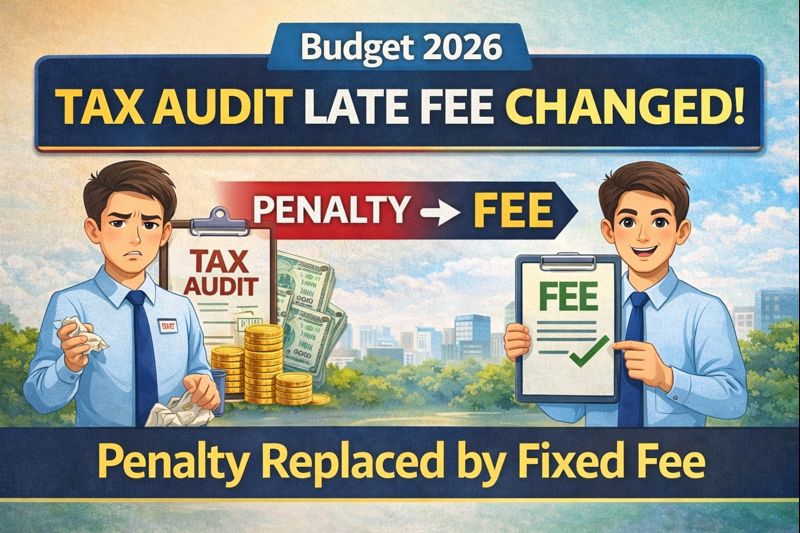
1. Change in Late Fee for Tax Audit – Section 446
Earlier Provision (Before Budget 2026)
Under Section 446 of the Act, penalty was leviable for failure to get accounts audited as required under the Act.
If a person failed, without reasonable cause, to get accounts audited or to obtain the audit report, the Assessing Officer could levy a penalty equal to the lower of:
- 0.5% of total sales / turnover / gross receipts, or
- ₹1,50,000
This penalty was discretionary and often became a subject matter of litigation, particularly in cases of minor or unintentional delays.
Proposed Amendment – Conversion of Penalty into Fee
Budget 2026 proposes to:
- Omit penalty under Section 446, and
- Convert it into a mandatory fee under proposed Section 428(c).
New Fee Structure (Tax Audit Delay)
A graded fee structure has been introduced:
| Nature of Default | Proposed Fee |
|---|---|
| Delay up to specified period | ₹75,000 |
| Delay beyond specified period | ₹1,50,000 |
📌 This fee is mandatory, non-discretionary, and not dependent on turnover or receipts.
Important Note:
While Section 446 has been omitted for audit default, it has been repurposed to deal with penalties relating to failure to furnish information or furnishing inaccurate information on crypto asset transactions.
2. Change in Penalty for Transfer Pricing Audit Report – Section 447
Earlier Provision
Under Section 447, failure to furnish an accountant’s report under Section 172 (applicable to international transactions and specified domestic transactions) attracted a fixed penalty of ₹1,00,000.
Proposed Amendment
The penalty under Section 447 is proposed to be:
- Converted into a fee, and
- Shifted to Section 428(4).
New Graded Fee Structure
| Period of Delay | Proposed Fee |
|---|---|
| Shorter delay | ₹50,000 |
| Longer delay | ₹1,00,000 |
This change introduces proportionality and fairness, especially in cases where the delay is procedural rather than intentional.
3. Change in Penalty for Statement of Financial Transactions – Section 454(1)
Earlier Provision
Under Section 454(1), failure to furnish a Statement of Financial Transactions (SFT) or reportable account attracted a penalty of:
- ₹500 per day for the period of default.
Proposed Amendment
Budget 2026 proposes to:
- Convert the penalty under Section 454(1) into a mandatory fee, and
- Shift it to Section 427(3).
This change again reflects the Government’s intention to treat technical reporting delays as compliance issues rather than offences.
4. Capping of Penalty under Section 454(2)
Earlier Provision
Under Section 454(2), if a person failed to furnish SFT even after receiving notice, a penalty of:
- ₹1,000 per day was leviable
- No upper monetary limit was specified
Proposed Relief
Budget 2026 proposes to introduce:
- An upper cap of ₹1,00,000 on penalty under Section 454(2)
This brings certainty and prevents disproportionate penalties in long-pending technical defaults.
5. Key Rationale Behind the Amendments
The Government has clearly stated that:
- Penalties for technical and procedural defaults lead to avoidable litigation
- Converting penalties into mandatory fees ensures certainty
- Fees are non-discretionary, reducing arbitrary assessments
- The approach aligns with a trust-based tax administration system
6. Effective Date and Applicability
- Effective from: 1 April 2026
- Applicable for: Tax Year 2026-27 and onwards
All defaults relating to earlier tax years will continue to be governed by the old provisions.
PENALTIES CONVERTED TO FEES
Effective from: 01.04.2026 (Tax Year 2026-27 onwards)
| Nature of Default | Earlier Penalty | New Fee (Budget 2026) |
|---|---|---|
| Failure to get accounts audited | Lower of: 0.5% of turnover / gross receipts or ₹1,50,000 | ₹75,000 / ₹1,50,000 (graded fee depending on period of delay) |
| Failure to furnish TP Report (Sec 172) | ₹1,00,000 | ₹50,000 / ₹1,00,000 (graded fee based on delay) |
| Failure to furnish SFT / Reportable Account | ₹500 per day (no upper cap) | Fee under Section 427(3) with upper limit of ₹1,00,000 |
| Penalty u/s 466 (Failure to furnish information) | ₹1,000 | ₹25,000 (fixed fee) |
Visit www.cagurujiclasses.com for practical courses