🇮🇳 Introduction – Why Banking Transactions Matter More Than Ever
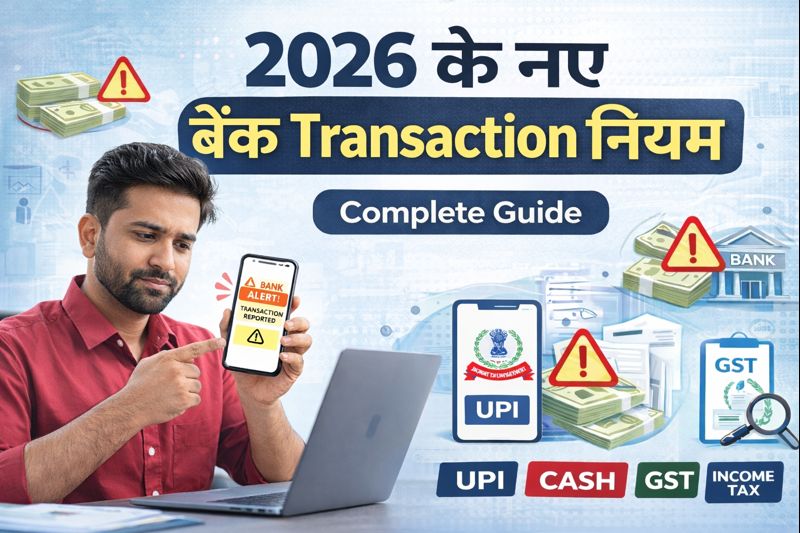
In today’s digital India, almost every financial activity — whether personal or business — leaves a banking footprint. From UPI payments and cash deposits to fixed deposits and GST-linked receipts, banks are no longer just service providers; they are reporting entities.
Most taxpayers believe that only large or suspicious transactions attract the attention of the Income Tax Department.
Reality is different.
Even routine transactions, if not understood or reported correctly, can:
- Trigger SFT reporting
- Reflect in AIS / Form 26AS
- Lead to income tax notices
- Cause bank account freeze
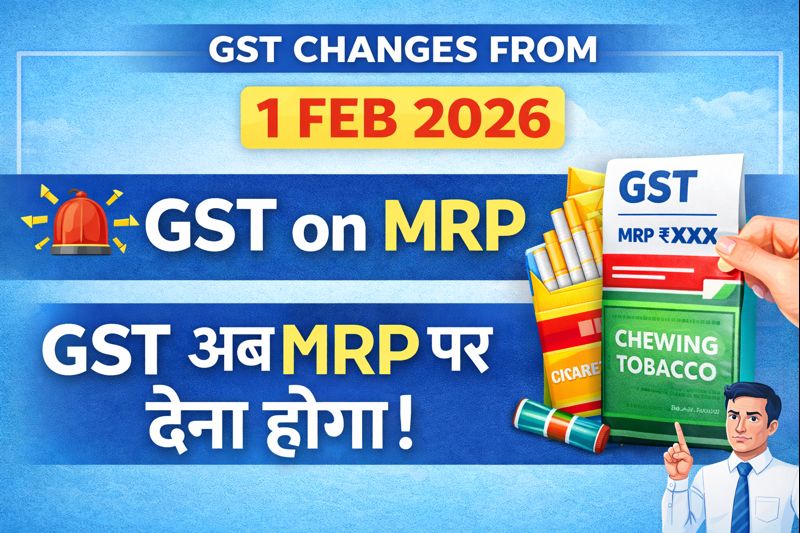
- Create GST registration or compliance issues
The objective of this article/video is not to create fear, but to create clarity.
Here, we will systematically explain:
- Banking transaction limits applicable in 2026
- High-risk transactions that invite scrutiny
- Cash, UPI, FD, and withdrawal rules
- GST and Income-tax linkage with bank accounts
- Practical compliance tips to stay notice-free
If you understand and follow the last section carefully, you can legally and confidently manage your finances without unnecessary tax stress.
1️⃣ Banking Transaction Modes & Limits
🟦 UPI (Unified Payments Interface)
UPI is the most widely used digital payment method.
- Standard daily limit: ₹1,00,000 per day per user across transactions.
- Per-transaction cap: Typically ₹1 lakh for normal payments; banks may vary limits.
- Enhanced limits for select categories: NPCI has increased UPI limits up to ₹5 lakh per day for certain payments (e.g., education, healthcare, government collections, capital markets) effective from 15 September 2025.
💡 Note: Banks may set even lower internal caps depending on policy. Always check with your bank.
🟦 IMPS (Immediate Payment Service)
- Maximum typically ₹5 lakh per transaction per day (varies by bank).
IMPS is fast and available 24×7, making it popular for high-value transfers (subject to bank’s cap).
🟦 NEFT (National Electronic Funds Transfer)
- Minimum: ₹1
- No statutory upper limit — allow large transfers (banks may impose day limits).
NEFT is useful for high-value transfers without UPI/IMPS limits.
🟦 RTGS (Real-Time Gross Settlement)
- Minimum: ₹2 lakh
- No fixed maximum (banks may impose limits).
RTGS is ideal for very large transfers where immediate settlement is needed.
2️⃣ Cash Transaction & Deposit Limits
🔸 Cash Deposit Reporting
Under Income Tax norms:
- Banks must report cash deposits aggregating ₹10 lakh or more in a savings account during a financial year to tax authorities.
- For current accounts, the reporting threshold is ₹50 lakh.
- financial institutions report Fixed Deposits (FD) aggregating to ₹10 lakh or more in a financial year to tax authorities.
👉 This is reporting, not a tax — but it appears in SFT (Specified Financial Transaction) reporting and can trigger scrutiny.
🔸 Cash Receipt & Payment Limits (Section 269ST)
- Receiving ₹2 lakh or more in cash from a single person or entity in one day is prohibited (except bank transfers).
- Receiving ₹2 lakh or more in a single transaction or for one occasion from the same person is also prohibited.
💡 If violated, penalty can be up to the amount received in cash.
🔸 Loan Payments / Cash Loans (Section 269SS & 269T)
- Accepting or repaying cash loans/deposits exceeding ₹20,000 in a year is prohibited (Section 269SS/269T).
💡 Penalty equals the amount of loan received or repaid.
3️⃣ TDS on Cash Withdrawals – Section 194N
Section 194N was introduced to discourage large cash withdrawals and promote digital transparency.
🧾 When is TDS Applicable?
TDS is required by banks on cash withdrawals from one or more accounts maintained by a person in a financial yearas follows:
| Condition | Threshold | TDS Applicability |
|---|---|---|
| If ITR filed for 3 preceding AYs | Withdrawals exceeding ₹1 crore | TDS @ 2% on amount above ₹1 crore |
| If no ITR filed for 3 preceding AYs | Withdrawals exceeding ₹20 lakh | TDS @ 2% (up to ₹1 crore) and 5% (above ₹1 crore) |
📌 TDS triggers only on cumulative withdrawals above threshold in a financial year.
📌 If you have accounts in multiple banks, limits are separate per bank.
4️⃣ Specified Financial Transactions (SFT)
High-value transactions that banks report to Income Tax authorities include:
- Cash deposits above ₹10 lakh (savings)
- Cash deposits above ₹50 lakh (current)
- Large digital receipts or withdrawals that raise red flags
These appear in AIS / Form 26AS and can be queried if not explained in your ITR.
5️⃣ GST Implications With Bank Accounts
🟡 GST Registration Threshold
- For sale of goods: ₹40 lakh turnover*
- For services: ₹20 lakh turnover
If your business receipts (e.g., via UPI/bank) exceed these limits, GST registration is mandatory.
⚠️ If you don’t add your bank account in GST portal within 30 days, your GST registration can be suspended
6️⃣ Mandatory Reporting in ITR & GST
📌 ITR Reporting
- All bank accounts held by you must be reported in ITR.
- Any unexplained SFT entries may attract notices or penalties.
📌 GST Portal Bank Linking
- Your primary bank account must be linked in GST portal.
- Failure can lead to GST number suspension.
7️⃣ Cash Payment Limit for Business Expenses
Under Section 40A(3):
- Business cannot claim cash payments exceeding ₹10,000 per person per day as a deductible expense in ITR.
This discourages large cash payments without clear bookkeeping.
8️⃣ Best Practices to Avoid Notices
✅ Separate personal & business accounts
➡ Business receipts/expenses → Current account
➡ Personal transactions → Savings account
✅ Classify UPI receipts clearly
Many taxpayers face scrutiny simply because UPI TPV inflows are not reconciled with business operations.
✅ Avoid heavy cash dealings
Especially unplanned cash deposits or withdrawals.
✅ File ITR consistently
If you file returns every year, you benefit from higher TDS thresholds under Section 194N.
📊 Quick Reference Table – Limits at a Glance
| Category | Limit | Key Notes |
|---|---|---|
| UPI standard per day | ₹1,00,000 | Banks may impose lower limits; select categories up to ₹5 lakh |
| IMPS per day | ₹5 lakh | Bank dependent |
| NEFT | No statutory limit | Banks may cap daily amount |
| RTGS | ≥ ₹2 lakh min | No capped max |
| Cash receipts (269ST) | ₹2 lakh | Prohibited for single person per day |
| SFT cash deposit (saving) | ₹10 lakh | Reportable to IT |
| SFT cash deposit (current) | ₹50 lakh | Reportable to IT |
| 194N TDS limit | ₹1 crore / ₹20 lakh | Based on ITR filing status |
| Business cash payment cap (40A) | ₹10,000 | Deduction disallowed above this |
| GST registration | ₹40L (goods) / ₹20L (services) | If receipts exceed, registration mandatory |
🧠 Summary – Key Takeaways
- Understand digital limits (UPI/IMPS/NEFT/RTGS) and follow bank rules.
- Avoid large cash receipts/payments without purpose — they attract reporting and penalties.
- File ITR timely — ensures higher thresholds for TDS on cash withdrawals.
- Link bank accounts in GST portal — avoid suspension.
- Maintain records of all high-value transactions to justify in ITR or GST returns.
Visit www.cagurujiclasses.com for practical courses