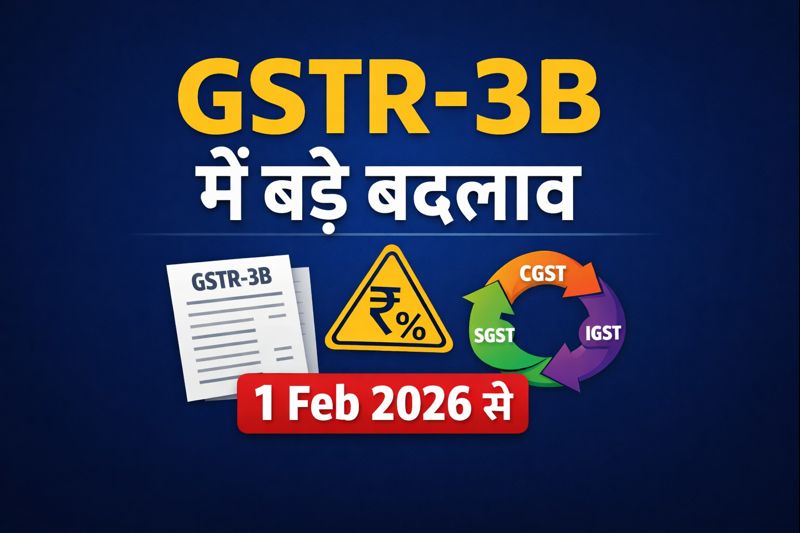
The Finance Bill, 2026 has proposed several important amendments in the Central Goods and Services Tax Act, 2017 (CGST Act) with the objective of simplifying compliance, reducing litigation, and improving refund and appellate mechanisms.
Unless specifically mentioned otherwise, these amendments will come into force from the date to be notified, concurrently with similar amendments by States and Union Territories.
1. Amendment in Section 15(3) – Post-Sale Discounts
Earlier Provision
Under Section 15(3) of the CGST Act, post-sale discounts were allowed to be excluded from the value of supply only if:
- The discount was established in terms of an agreement entered into before or at the time of supply, and
- The recipient reversed the proportionate input tax credit (ITC) attributable to the discount.
In practice, this requirement of linking discounts to a prior agreement resulted in disputes and denial of tax benefit where discounts were given later without explicit contractual linkage.
Amendment Introduced (Finance Bill, 2026 – Clause 137)
- The requirement of linking post-sale discounts with a pre-existing agreement is done away with.
- Section 15(3) now refers to issuance of a credit note under Section 34, provided the recipient reverses the corresponding ITC.
Impact & Practical Benefit
✔ Greater flexibility in granting commercial discounts
✔ Reduction in litigation on valuation issues
✔ Alignment with actual business practices
This change recognises that discounts are often decided post-supply and should not be denied GST benefit merely due to absence of a prior agreement.
2. Amendment in Section 34 – Credit Notes
Earlier Provision
Section 34 governed the issuance of credit notes but did not explicitly refer back to Section 15 (valuation provisions), leading to interpretational issues on whether credit notes issued for discounts were fully aligned with valuation rules.
Amendment Introduced (Finance Bill, 2026 – Clause 138)
- Section 34 is amended to explicitly include reference to Section 15 of the CGST Act.
Impact
✔ Legal clarity between valuation and credit note provisions
✔ Strengthens the legitimacy of post-sale discount credit notes
✔ Reduces departmental objections during audits and assessments
3. Amendment in Section 54(6) – Provisional Refund for Inverted Duty Structure
Earlier Provision
- Provisional refund (90%) under Section 54(6) was available mainly for:
- Zero-rated supplies (exports)
- Refunds arising from Inverted Duty Structure (IDS) were not expressly covered for provisional refund.
Amendment Introduced (Finance Bill, 2026 – Clause 139)
- Provisions of provisional refund are extended to refunds arising out of inverted duty structure.
Impact
✔ Faster liquidity for manufacturers and suppliers under IDS
✔ Reduced working capital blockage
✔ Significant relief for sectors with higher input GST rates
This is a major taxpayer-friendly amendment.
4. Amendment in Section 54(14) – Threshold Limit for Refund Sanction
Earlier Provision
- Section 54(14) prescribed a threshold limit below which refunds (especially export refunds with payment of tax) were processed differently.
- This led to procedural delays and inconsistencies.
Amendment Introduced (Finance Bill, 2026 – Clause 139)
- The threshold limit is removed for sanction of refund claims in case of goods exported out of India with payment of tax.
Impact
✔ Uniform refund processing irrespective of refund amount
✔ Faster sanction for small exporters
✔ Reduction in administrative discretion
5. Insertion of Section 101A(1A) – Interim National Appellate Authority
Earlier Provision
- Appeals against conflicting Advance Ruling decisions of different States were to be heard by the National Appellate Authority (NAA) under Section 101B.
- However, NAA had not been constituted, leaving taxpayers without an appellate remedy.
Amendment Introduced (Finance Bill, 2026 – Clause 140)
- A new Section 101A(1A) is inserted to:
- Empower the Central Government to notify an existing Authority / Tribunal to hear appeals under Section 101B pending constitution of NAA.
- Sub-sections (2) to (13) of Section 101A will not apply where such authority is empowered.
- An Explanation clarifies that existing authority includes a tribunal.
📌 Effective Date: 1st April 2026
Impact
✔ Removes long-standing appellate vacuum
✔ Provides certainty to taxpayers facing conflicting advance rulings
✔ Improves dispute resolution mechanism under GST
Amendment in IGST Act – Place of Supply for Intermediary Services
Earlier Provision
Under Section 13(8)(b) of the IGST Act, 2017, the place of supply for intermediary services was deemed to be the location of the supplier of services.
Due to this deeming fiction:
- Intermediary services provided from India to foreign clients were treated as taxable in India.
- Such services were not considered as export of services, leading to GST liability and significant litigation.
Amendment Introduced (Finance Bill, 2026 – Clause 141)
- Clause (b) of sub-section (8) of Section 13 is omitted.
- As a result, the place of supply for intermediary services will now be determined as per the default rule under Section 13(2) of the IGST Act.
Under Section 13(2), the place of supply is the location of the recipient of services.
Impact & Practical Benefit
✔ Intermediary services provided to overseas clients will now qualify as export of services, subject to fulfillment of other conditions
✔ GST will generally not be payable on such cross-border intermediary services
✔ Major relief to service exporters, consultants, agents, and facilitators
✔ Long-standing litigation on intermediary services expected to end
Visit www.cagurujiclasses.com for practical courses