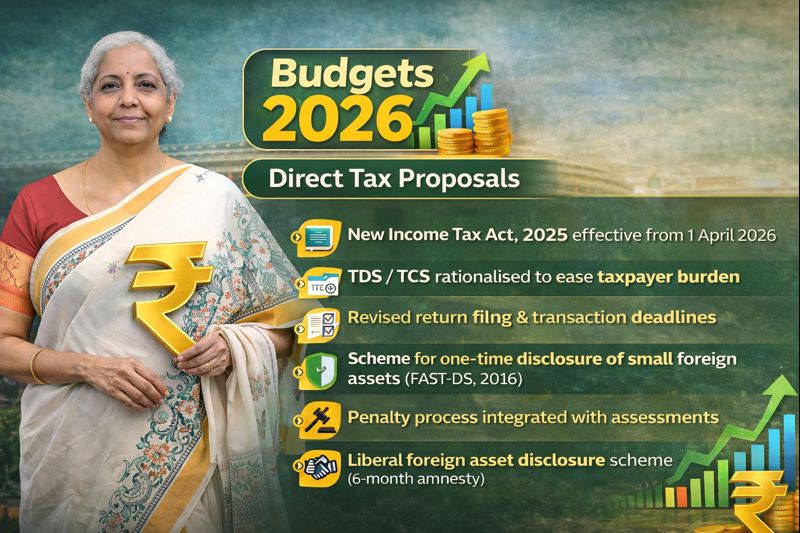
The Government has undertaken one of the biggest compliance reforms in Indian direct taxation with the introduction of the Income-tax Act, 2025 and the Draft Income-tax Rules, 2026.
A key pillar of this reform is the complete restructuring, simplification, and renumbering of Income-tax Forms.
This article explains:
- Why forms are being changed
- Which major forms are renumbered
- How this impacts taxpayers and professionals
- What to expect going forward
Background of the Reform
The Income-tax Act, 2025, proposed to be effective from 1 April 2026, aims to:
- Simplify language
- Reduce litigation
- Remove redundancy
- Leverage technology for compliance
To support this new Act, the Draft Income-tax Rules, 2026 have been released in the public domain for stakeholder feedback.
Scale of the Change
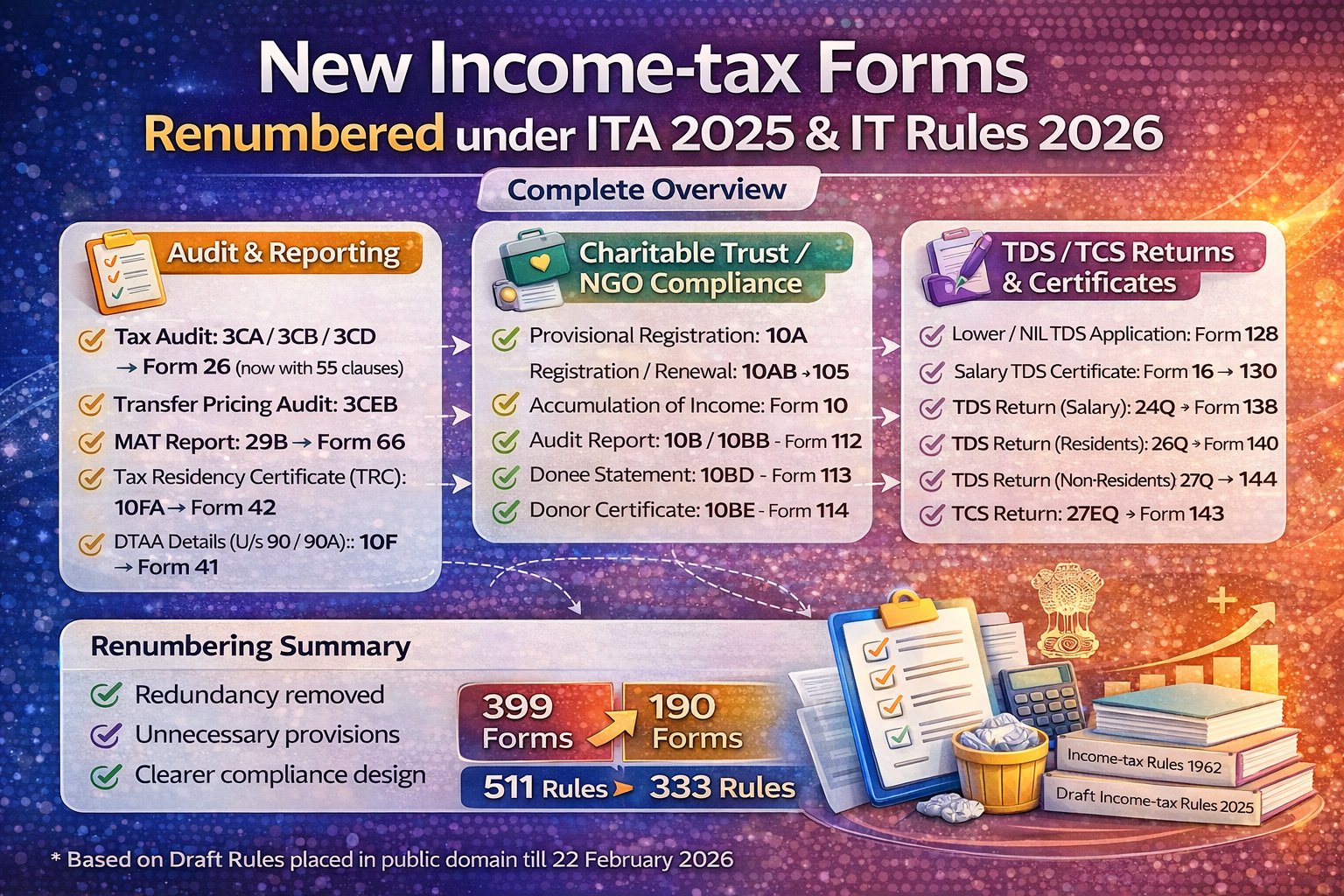
| Particulars | Old Rules (1962) | Draft Rules (2026) |
|---|---|---|
| Number of Rules | 511 | 333 |
| Number of Forms | 399 | 190 |
This reduction has been achieved through consolidation, standardisation, and elimination of repetitive reporting.
1. Audit & Reporting Forms – Renumbered
Audit and reporting forms have been completely restructured and consolidated.
| Earlier Form | Purpose | New Form |
|---|---|---|
| 3CA / 3CB / 3CD | Tax Audit Report | Form 26 (with 55 segment-wise clauses) |
| 3CEB | Transfer Pricing Audit | Form 48 |
| 29B | MAT Report | Form 66 |
| 10FA | Tax Residency Certificate (TRC) | Form 42 |
| 10F | DTAA Details (u/s 90 / 90A) | Form 41 |
🔍 Key Improvement:
Multiple audit reports are merged into single, logically segmented forms, reducing duplication and interpretational conflicts.
2. Charitable Trust / NGO Compliance – Fully Reworked
Trust and NGO compliance has historically been complex. Under the new regime, forms are renumbered and streamlined.
| Earlier Form | Purpose | New Form |
|---|---|---|
| 10A | Provisional Registration | Form 104 |
| 10AB | Registration / Renewal | Form 105 |
| Form 10 | Accumulation of Income | Form 109 |
| 10B / 10BB | Audit Report | Form 112 |
| 10BD | Donee Statement | Form 113 |
| 10BE | Donor Certificate | Form 114 |
🔍 Key Improvement:
Clear segregation between registration, audit, accumulation, and donation reporting, reducing chances of technical rejection.
3. TDS / TCS Returns & Certificates – Renumbered and Standardised
TDS/TCS compliance has been modernised with logical renumbering and standardisation of data fields.
| Earlier Form | Purpose | New Form |
|---|---|---|
| Form 13 | Lower / NIL TDS Application | Form 128 |
| Form 16 | Salary TDS Certificate | Form 130 |
| 24Q | TDS Return – Salary | Form 138 |
| 26Q | TDS Return – Residents | Form 140 |
| 27Q | TDS Return – Non-Residents | Form 144 |
| 27EQ | TCS Return | Form 143 |
🔍 Key Improvement:
Forms are designed for automated validation, reconciliation, and centralised processing, reducing errors and notices.
4. Other Important Renumbered Forms
Several high-usage compliance forms have also been renumbered:
| Earlier Form | Purpose | New Form |
|---|---|---|
| Form 26AS | Annual Tax Statement | Form 168 |
| 15CA | Foreign Remittance | Form 145 |
| 15CB | CA Certificate for Remittance | Form 146 |
| 61A | SFT Filing | Form 165 |
5. Philosophy Behind New Rules & Forms
The Draft Rules and Forms follow the same philosophy as the Income-tax Act, 2025:
✔ Simplified Language
Legal and operational language has been simplified to avoid ambiguity.
✔ Standardised Information
Common data fields are standardised across forms to reduce repetitive disclosures.
✔ Smart Forms
Forms are designed with:
- Pre-fill capability
- Automated reconciliation
- Built-in validations
✔ Technology-Driven Compliance
This enables:
- Centralised processing
- Data-driven decision making
- Better taxpayer services
6. Public Consultation & Transparency
- Draft Rules and Forms were placed in the public domain for 15 days (up to 22 February 2026).
- Two navigators have been released:
- Old Rules vs New Rules mapping
- Old Forms vs New Forms mapping
- Feedback is invited rule-wise and form-wise, making the process participative.
7. What This Means for Taxpayers & Professionals
For Taxpayers
- Fewer forms to understand
- Reduced duplication
- Easier and more intuitive filing
For Professionals
- Initial learning curve
- Long-term reduction in compliance burden
- Better clarity and lower litigation risk
For the Tax System
- Cleaner data
- Better analytics
- More predictable administration
The renumbering and restructuring of Income-tax Forms under the Income-tax Act, 2025 and Draft Rules, 2026 is not merely a cosmetic change.
It represents a fundamental shift towards simplified, technology-enabled, and taxpayer-friendly compliance.
Visit www.cagurujiclasses.com for practical courses